en
en 



Call
+8613406350006


This week, tube billet prices rose by 30–50 yuan/ton, with strengthening costs providing bottom support for seamless pipe prices, and mainstream mills raised their prices. Meanwhile, mill output continued to decline, mill inventories fell further, and supply pressure eased somewhat. However, downstream end-user enterprises showed only moderate enthusiasm for purchasing at higher prices, and demand increments remained relatively limited. For overseas buyers sourcing seamless steel pipes from China, this week marks a clear inflection: the cost floor has been confirmed and is now rising — the low-price procurement window highlighted in recent weeks is beginning to close.
Seamless Pipe Prices: According to Mysteel survey data, as of August 28, the national average price for 108×4.5mm seamless pipe across 28 major cities stood at 4,261 yuan/ton, up 7 yuan/ton week-on-week — confirming the price stabilization trend and the beginning of a firm shift.
Raw Materials: National tube billet prices strengthened this week. Shandong billet prices rose 50 yuan/ton week-on-week, and Jiangsu billet prices rose 30 yuan/ton week-on-week. The north-south billet price gap narrowed to 100 yuan/ton, a 20 yuan/ton reduction week-on-week. Recent increases in dual-coal prices have driven raw material costs upward, and billet prices have risen on the back of cost-side momentum. For overseas buyers, the sustained billet price increase is the strongest signal yet that the raw material cost floor has moved decisively higher — procurement costs are now on an upward trajectory.
Mill Price Adjustments: According to a Mysteel survey of 30 sample seamless pipe mills, most mainstream mills raised prices this week, with increases ranging from 30–70 yuan/ton. For international buyers, this is the first broad-based mill price increase in weeks — the negotiation leverage that high inventories previously provided is now visibly eroding as mills regain pricing confidence.
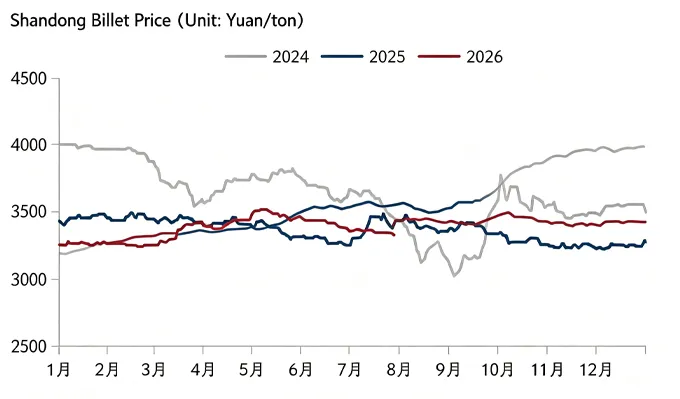
In terms of profitability, billet-rolling seamless pipe mill profits adjusted within a narrow range this week. Shandong billet-rolling mill profit stood at 30 yuan/ton, down 20 yuan/ton week-on-week. Jiangsu billet-rolling mill profit reached 210 yuan/ton, up 30 yuan/ton week-on-week. In the short term, mill profits are expected to maintain a low-level oscillation pattern. On one hand, billet prices are supported by the raw material side and are more likely to rise than fall, continuously pressuring mill margins. On the other hand, downstream demand is weak, seamless pipe finished product prices are struggling to keep pace with cost increases, and mills find it difficult to transfer cost pressure through price hikes. For overseas buyers, this margin squeeze explains why mill price increases have been measured rather than aggressive — but with costs rising underneath, the direction of finished pipe prices is now firmly upward.
The East China seamless pipe market moved up slightly this week. Shanghai and Hangzhou mainstream prices rose 20 yuan/ton each, quoting 4,280 yuan/ton and 4,170 yuan/ton respectively, while Nanjing held steady at 4,170 yuan/ton. Cost-side support was strong: Jiangsu billet rose 80 yuan/ton and Shandong rose 50 yuan/ton, with mainstream mill ex-factory prices up 30–70 yuan/ton. East China market sales volumes remained at off-season levels, with downstream procurement primarily essential-need-driven and transactions relatively weak. In the short term, East China seamless pipe prices are expected to continue trending steady to firm. For international buyers, East China — home to major export-oriented mills and ports — is often the leading indicator for national price direction. The confirmed upward move in this region suggests that export quotations will firm correspondingly in the coming weeks.
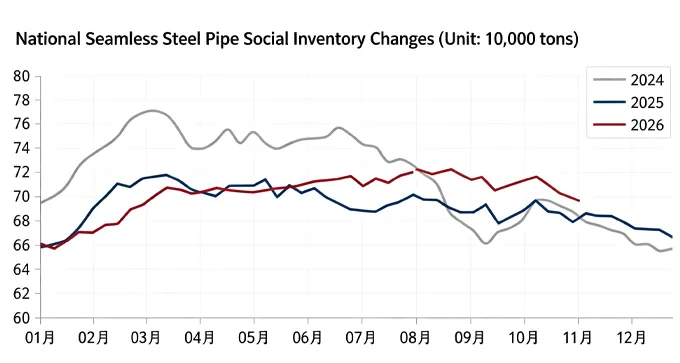
Social Inventory: According to the latest Mysteel survey of 123 national seamless pipe distributors, sample enterprise social inventory stood at 713,600 tons, down 3,200 tons week-on-week. The social inventory decline reflects recent mill output contraction and a slower pace of market arrivals. At the same time, distributors are focused on destocking their existing holdings, and proactive restocking willingness remains weak.
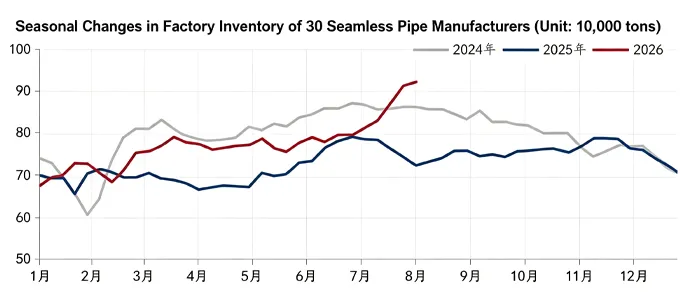
Mill Inventory: The national seamless pipe weekly production survey (30 sample producers, 101 production lines) showed mill inventory at 905,200 tons, down 6,000 tons week-on-week and down 8,000 tons month-on-month. Raw material inventory stood at 339,300 tons, up 3,100 tons week-on-week and up 15,600 tons month-on-month. Recently, mill maintenance and restarts have alternated, and the shutdown of some production lines has contracted the supply side, allowing mill inventories to destock slightly. As maintenance continues, mill inventories are expected to decline further in the short term, helping to ease mill inventory pressure. For international buyers, this is now the third consecutive week of mill inventory declines — the high-inventory environment that gave buyers strong negotiation leverage is steadily normalizing, and with it, the window for bottom-level pricing continues to narrow.
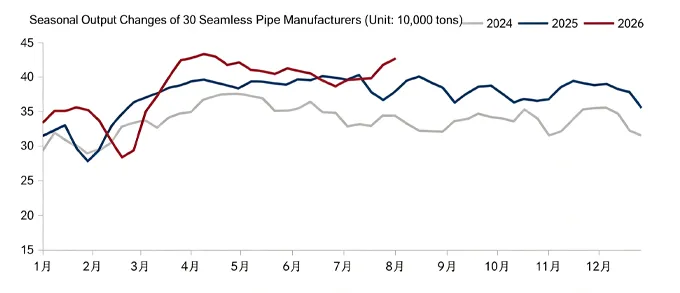
This week, output stood at 377,600 tons, down 800 tons week-on-week and down 47,300 tons month-on-month. Capacity utilization rate was 75.73%, down 0.15 percentage points week-on-week and down 9.49 percentage points month-on-month. Operating rate was 68.32%, down 1.98 percentage points week-on-week and down 9.9 percentage points month-on-month. Affected by low profits, mills show strong willingness to actively control production, and output is expected to continue declining next week. Supply-side contraction helps ease the current supply-demand imbalance and provides some boost to market confidence. However, whether production declines can effectively translate into inventory destocking still depends on the actual recovery of downstream demand. For overseas buyers, the dramatic month-on-month operating rate drop of 9.9 percentage points signals substantial capacity withdrawal — as available supply tightens, both lead times and pricing leverage will increasingly favor the seller side. Buyers with near-term requirements should consider finalizing orders promptly.
On the cost side, billet prices still have room to rise with support from dual-coal and raw material prices, and mills show strong price-protecting willingness, forming solid bottom support for seamless pipe prices. On the supply side, mill output continues to decline and mill inventories are falling further — supply contraction has eased market pressure and provides price support. On the demand side, the off-season is gradually winding down, terminal demand is expected to improve at the margin, but the possibility of a large-scale volume release remains low, and the actual recovery of downstream procurement still needs monitoring. Taking these factors together, next week the seamless pipe market is supported by the dual tailwinds of strengthening costs and shrinking supply. Price centers are expected to move up slightly, but demand follow-through will constrain the height of any increase. Domestic seamless pipe prices are likely to trend firm with oscillation. For international buyers, the market has now clearly turned: costs are rising, supply is shrinking, and prices are moving up. The strategic question is no longer whether to wait for lower prices — it is how quickly current requirements can be locked in before further increases take hold.
The national seamless steel pipe market reached a turning point this week. Tube billet prices rose 30–50 yuan/ton, mainstream mills raised ex-factory prices by 30–70 yuan/ton, and the national average price climbed to 4,261 yuan/ton. Supply-side contraction deepened: output fell to 377,600 tons with operating rates down to 68.32% — a 9.9 percentage point decline month-on-month — while mill inventories declined for the third consecutive week to 905,200 tons. The dual-coal price rally continues to feed through to billet costs, and mills are now actively protecting prices rather than discounting. For international buyers sourcing seamless steel pipes from China, the market dynamics have decisively shifted. The conditions that created the buyer's market — high inventories, weak costs, desperate mills — are unwinding week by week. In their place: rising raw material costs, tightening supply, and mills regaining pricing power. Buyers who secured orders in recent weeks locked in near-bottom pricing. For those still evaluating, the calculus has changed — waiting now carries the risk of paying progressively higher prices, while acting promptly still allows securing levels that remain well below where they are likely to head as cost support strengthens and the off-season ends.