en
en 




Call
+8613406350006


The seamless pipe market is navigating a challenging Q4, with the national average price likely to shift further downward. After an initial macro-driven rebound in Q3 quickly faded, the market has settled into a phase of weak demand and modest price contraction. Mills are under significant pressure, currently operating at a loss near the cost line, and inventory digestion remains slow. Although maintenance efforts have slightly curtailed supply, the fundamental weak demand, coupled with the arrival of the Northern off-peak season, suggests that the market's current downward trend is likely to continue in the short term, prioritizing inventory turnover.
The seamless pipe market in 2025 has been characterized by a volatile downward trend, with price fluctuation ranges and amplitudes significantly reduced throughout the year. The first and second quarters saw prices mostly declining. While the price hit the annual low in July, a brief rebound occurred in August, driven by favorable macroeconomic policies. However, the subsequent lack of substantial demand improvement for seamless pipes caused the upward momentum to stall, and market sentiment cooled rapidly in September. The market performance in October remained lukewarm, with general purchasing data around the National Day holiday highlighting a prominent supply-demand imbalance. With the onset of the traditional off-peak season in the North, the persistence of the current weak trend in seamless pipes is highly probable.
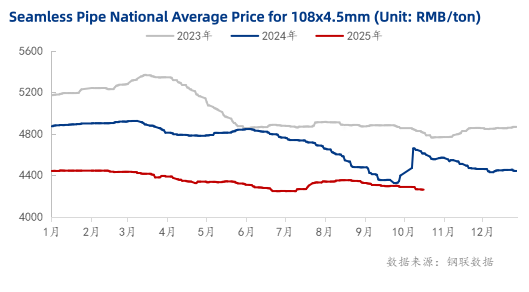
The national seamless pipe price reached its highest point of 4,446 yuan/ton in January, sinking to its annual low of 4,246 yuan/ton in July, reflecting an overall decline of 200 yuan/ton for the year. As of October 24, the national average price for seamless steel pipe was 4,261 yuan/ton, a decrease of 26 yuan/ton compared to the price before the National Day holiday, and a year-on-year decrease of 293 yuan/ton. Following the holiday, a combination of falling raw material costs, a macro policy "window of inactivity," and off-peak season demand caused prices in most mainstream cities to decline, resulting in a slight drop in the national average price.
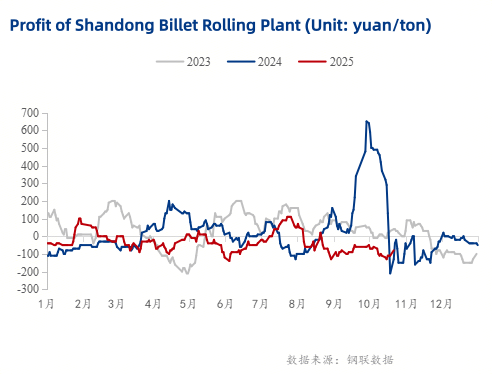
Hot-rolled pipe billet prices in Shandong saw a month-on-month decrease of 40-50 yuan/ton in October. Mainstream seamless pipe mills, influenced by the drop in raw material costs, saw synchronous price declines. Theoretical mill profits are currently floating around -100 yuan/ton. As of October 24, taking 20# hot-rolled, 108x4.5mm seamless pipe as an example, the theoretical profit for sample mills in Shandong was -80 yuan/ton. This represented a 20 yuan/ton decrease month-on-month, despite a slight 40 yuan/ton weekly increase. With mill profits continually squeezed and supply remaining high, it will be difficult for mill profitability to turn positive in the short term.
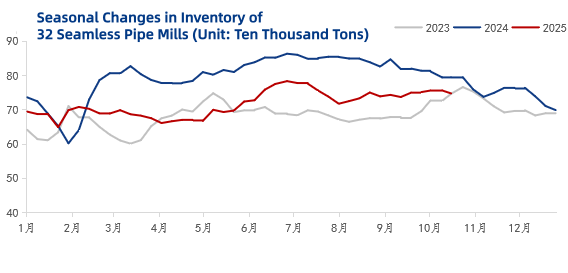
Recently, raw material prices have been volatile and weak. Pipe mill finished product orders have been moderate, leading to a slowing pace of raw billet procurement and a corresponding decrease in raw material inventory. The trading atmosphere in the pipe billet market remains average. Although pipe mills have resorted to voluntary line stoppages and production cuts due to long-term inverted profits, the slow order intake has meant that the rate of mill inventory decrease has been sluggish, resulting in periods of inventory accumulation and tightening supply-side pressure. The latest data indicates that weekly seamless pipe mill output was 364,200 tons, a month-on-month decrease of 21,500 tons. Capacity utilization was 73.04%, a month-on-month decrease of 4.31%. Mill inventory stood at 747,800 tons, a month-on-month decrease of 2,200 tons. Since mill maintenance is largely complete, production is expected to recover its pace soon. However, the slow transfer of finished inventory to the social sector means that mill-side pressure still persists.