en
en 



Call
+8613406350006


This week, raw material prices showed mixed movements, tube billet prices remained flat week-on-week, and the cost side did not form strong support. Some pipe mills continued to lower ex-factory prices. Weekly output saw a slight decline, and a mill inventory inflection point has emerged. Market trading atmosphere was moderate, with downstream procurement primarily driven by essential demand. For overseas buyers sourcing seamless steel pipes from China, the emergence of a mill inventory turning point combined with stabilizing billet costs signals that the current price floor is forming — a critical window for locking in procurement before potential cost-driven recovery.
Seamless Pipe Prices: According to Mysteel survey data, as of August 21, the national average price for 108×4.5mm seamless pipe across 28 major cities stood at 4,254 yuan/ton, up 1 yuan/ton week-on-week — a marginal increase signaling price stabilization.
Raw Materials: National tube billet prices were largely stable this week. Shandong billet prices held flat week-on-week, while Jiangsu billet prices rose by 0–10 yuan/ton week-on-week. The north-south billet price gap remained at 120 yuan/ton, unchanged week-on-week. Under dual-coal production restriction policies, raw material supply is tightening, and billet prices may trend steady to firm. For overseas buyers, stabilizing billet prices suggest the cost floor is forming — further price declines from the raw material side appear increasingly unlikely.
Mill Price Adjustments: According to a Mysteel survey of 30 sample seamless pipe mills, some major mills lowered ex-factory prices by 30–50 yuan/ton. While mill price reductions offer immediate cost savings for international buyers, the narrowing adjustment range compared to previous weeks indicates mills are approaching their pricing floor.
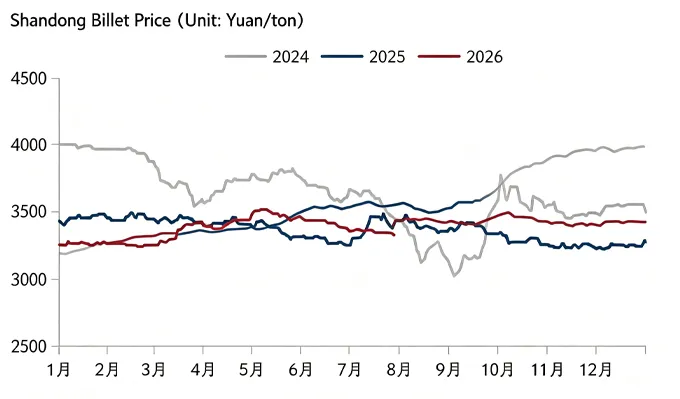
In terms of profitability, billet-rolling seamless pipe mill profits saw slight recovery this week. Shandong billet-rolling mill profit remained at 50 yuan/ton, unchanged week-on-week. Jiangsu billet-rolling mill profit reached 200 yuan/ton, up 30 yuan/ton week-on-week. For overseas buyers, the persistently thin Shandong margins confirm that mills are operating near breakeven — current ex-factory price levels are close to the cost floor, meaning limited room for further price concessions.
East China: Mainstream seamless pipe prices held steady this week, with some local markets seeing slight upward probes and regional performance diverging. Shanghai 108×4.5mm quoted at 4,260 yuan/ton, flat week-on-week. Nanjing same spec at 4,170 yuan/ton, also stable. Hangzhou saw a slight increase of 20 yuan/ton to 4,150 yuan/ton. On the cost side, Shandong and Jiangsu billet prices firmed slightly, but major Shandong mills' ex-factory quotes remained steady to weak, and spot prices lacked upward momentum. Supply-side, both seamless pipe output and mill inventory declined slightly this week, with some specifications becoming tight, providing some price support. Demand remained constrained by seasonal factors, with downstream procurement on a need-only basis and market trading subdued. Distributors reported steady sales pace with small price concessions in actual transactions. Overall, cost support has strengthened somewhat, but demand release remains limited. Market sentiment is cautious and watchful. Next week, East China seamless pipe prices are expected to remain largely stable, with the possibility of slight upward movement in some markets due to tight specifications. For international buyers, the Hangzhou price uptick and tightening specification availability suggest that waiting further may mean paying more — particularly for buyers requiring specific dimensions.
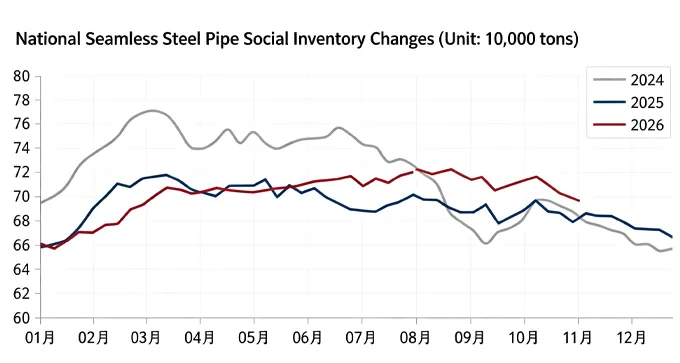
Social Inventory: According to the latest Mysteel survey of 123 national seamless pipe distributors, sample enterprise social inventory stood at 716,800 tons, down 1,500 tons week-on-week. Off-season market sales were poor, distributor turnover was sluggish, restocking willingness was low, and inventory declined slightly.
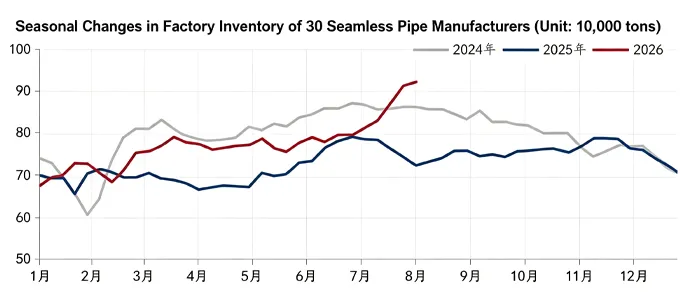
Mill Inventory: The national seamless pipe weekly production survey (30 sample producers, 101 production lines) showed mill inventory at 911,200 tons, down 18,300 tons week-on-week but up 6,500 tons month-on-month. Raw material inventory stood at 336,200 tons, up 4,100 tons week-on-week and up 31,900 tons month-on-month. Due to weak off-season demand, mill order intake has been sluggish and inventory continues to accumulate. However, as mill output gradually decreases, inventory is expected to decline slightly. For international buyers, the week-on-week mill inventory decline of 18,300 tons confirms the inflection point has arrived — mills are beginning to destock. This means current high-inventory-driven negotiation leverage will gradually diminish as inventory normalizes.
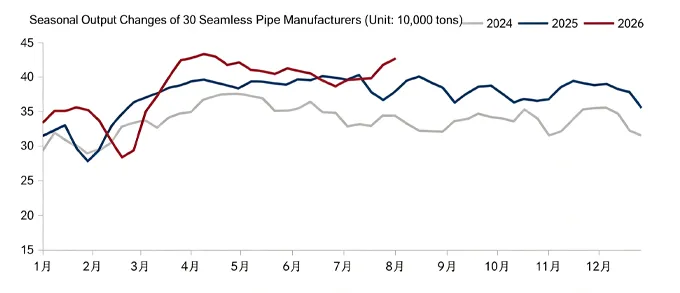
This week, output stood at 378,400 tons, down 6,600 tons week-on-week and down 37,100 tons month-on-month. Capacity utilization rate was 75.88%, down 1.32 percentage points week-on-week and down 7.45 percentage points month-on-month. Operating rate was 70.3%, down 2.97 percentage points week-on-week and down 3.93 percentage points month-on-month. Output declined slightly this week. With mill inventory pressure persisting, production is expected to continue decreasing next week. For overseas buyers, the sharp month-on-month output decline of 37,100 tons and dropping operating rates signal meaningful supply tightening — placing orders before reduced output translates into longer lead times and tighter availability is advisable.
The seamless pipe market's oversupply pattern continued this week. Jiangsu billet prices trended firm, and national seamless pipe prices overall showed narrow-range oscillation. On the supply side, mill output declined slightly, but mill inventories remained elevated and supply pressure has not yet eased. On the demand side, high temperatures, heavy rainfall, and the traditional off-season suppressed downstream procurement enthusiasm. The market mostly maintained essential procurement, and overall trading was flat. However, the Shanxi coal mine production restriction policy implemented in August has reduced coking coal supply, providing cost support for billets. Billet prices are expected to gradually stabilize and recover going forward. Considering supply-demand and cost factors together, the seamless pipe market is expected to continue oscillating in a narrow range next week. For international buyers, the convergence of declining production, inventory destocking, and building cost support from coal restrictions indicates the current price window is narrowing — buyers with Q3/Q4 procurement plans should consider advancing orders to secure current pricing before cost recovery takes hold.
The national seamless steel pipe market remained in an oversupply pattern this week, with the national average price edging up marginally to 4,254 yuan/ton. A key development is the emergence of a mill inventory inflection point — mill inventory declined 18,300 tons week-on-week, marking the first destocking signal after weeks of accumulation. Tube billet prices stabilized, and Shanxi coal mine production restrictions are building cost support from the raw material side. Mill output continued to decline, with operating rates dropping to 70.3% and capacity utilization at 75.88%. For international buyers sourcing seamless steel pipes from China, several converging signals point to a narrowing procurement window: mill margins remain near breakeven (limiting further price downside), inventory destocking has begun (reducing negotiation leverage over time), production is tightening (threatening future availability and lead times), and raw material cost support is building (potentially driving prices upward). Regional price variations also offer sourcing optimization opportunities, with Tianjin at 4,070 yuan/ton and Changsha at 4,120 yuan/ton representing the lowest price points nationally. Buyers who act before cost recovery and supply tightening fully materialize can secure the most competitive pricing and favorable delivery terms.