en
en 


Call
+8613406350006


The steel pipe import and export market is at a critical juncture of "Stable Volume, Improved Quality." Despite global economic weakness and geopolitical conflicts, China's total steel exports increased by 4.2% year-on-year in January-August 2025, reaching a historical high in value, driven by a structural shift towards high-value-added products. This transformation reflects China's industrial upgrade and a pivot towards regional cooperation, particularly the Belt and Road Initiative (BRI). The outlook points to a future of "high-end, regionalized, and green" development for the steel pipe sector.
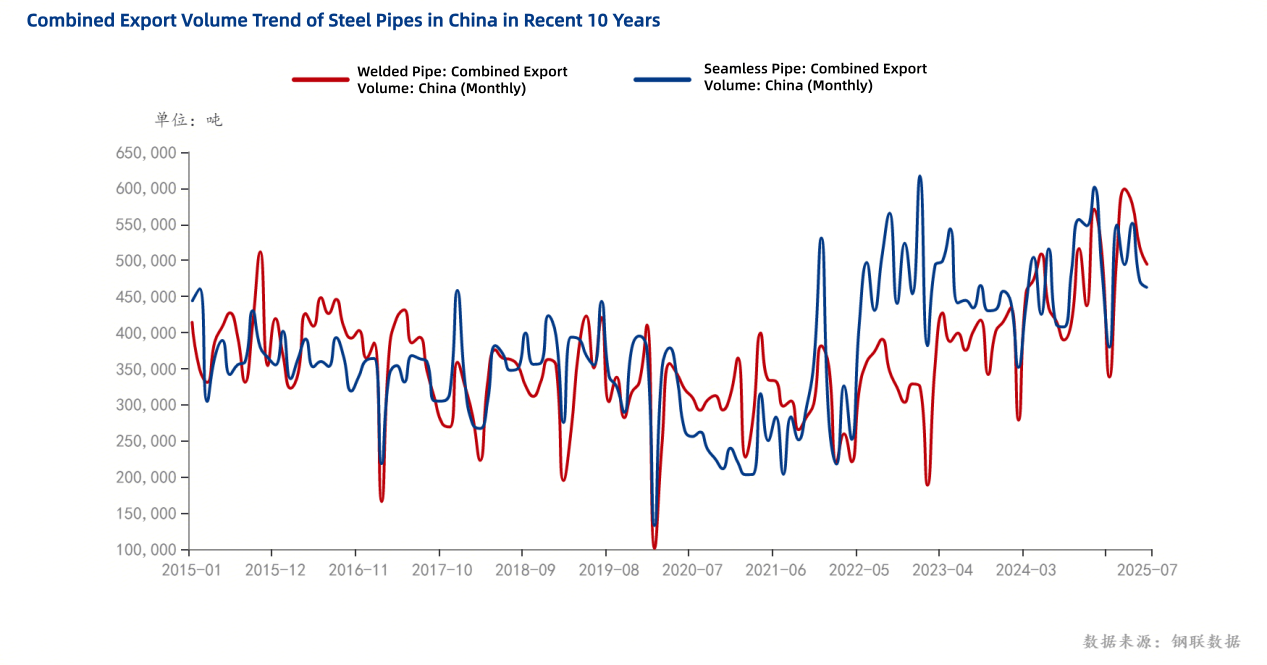
Over the past ten years, China's steel pipe export volume has generally followed a "first decline, then rise" trend.
Between 2015 and 2019, affected by the global economic downturn and escalating trade frictions, monthly welded pipe export volumes fluctuated in the 300,000 to 450,000 tons range.
After 2020, influenced by factors like domestic capacity optimization and international market recovery, export volumes gradually climbed. Monthly export volume surpassed the 500,000 tons mark in 2024, reaching a peak for the last decade.
Recent export growth mainly stems from a "volume-for-price" strategy and the development of Belt and Road markets. Developing countries in Southeast Asia and South America have become the primary export destinations, with demand for seamless pipes in the oil and gas sector being the core driver.
The export structure is optimizing towards "high value-added, segmented fields," with welded pipes primarily used for construction and industrial steel, and seamless pipes for high-end varieties like oil and gas pipelines and boiler tubes.
Currently, steel pipe exports are highly concentrated in "Belt and Road" countries, with the top 10 export destinations accounting for over 50% of welded pipe exports and over 55% of seamless pipe exports.
From a long-term export potential perspective, the deepening of "Belt and Road" international cooperation and green energy projects will drive export structure upgrades. It is expected that steel pipe export volume will continue to rise in 2025, with a sustained collaborative growth trend between welded and seamless pipes. The future requires seizing the opportunities presented by the "Belt and Road" and green transformation to consolidate global market competitiveness.
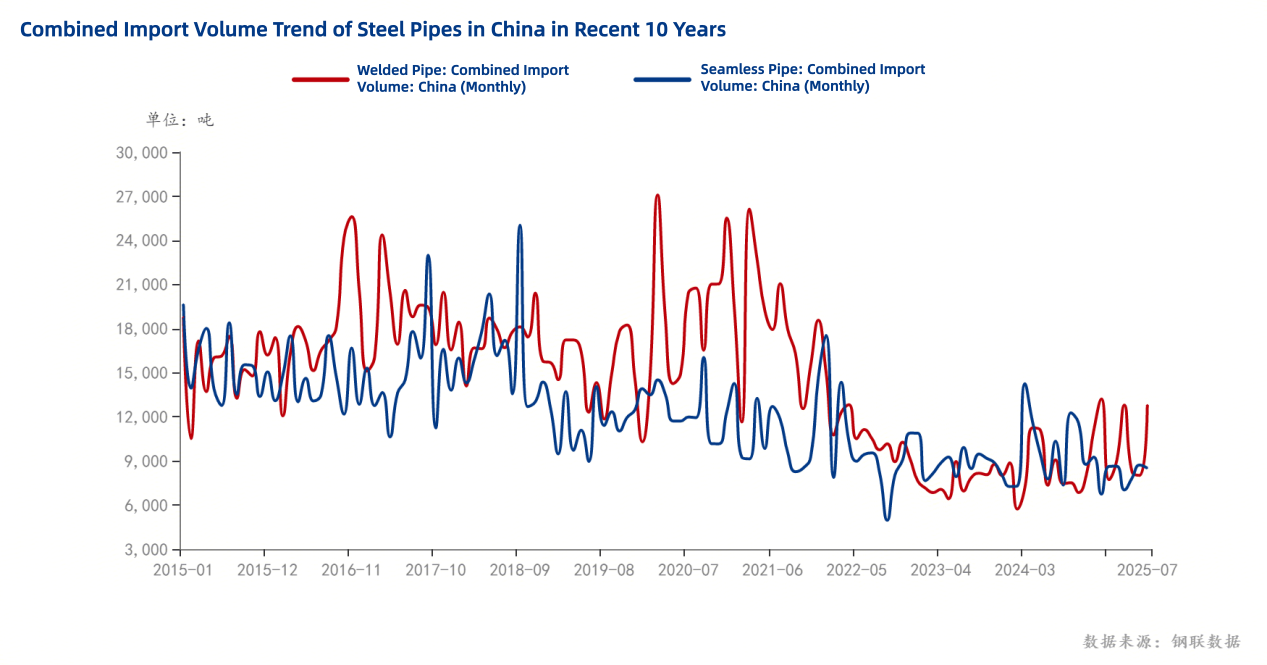
Over the past ten years, steel pipe imports have exhibited a characteristic of "overall volatile decline."
Welded Pipe Imports: Welded pipe imports remained relatively high between 2015 and 2018, then entered a continuous downward channel after 2018, reaching a low point in recent years by 2022. From 2023 to 2025, welded pipe imports showed a rebounding trend, with the import volume recovering to about 12,000 tons in July 2025. This change is closely linked to the domestic supply and demand structure. Imported welded pipes are often high-end, special-purpose products, reflecting a continuing domestic reliance on imports for premium welded pipes, although the overall import scale is contracting due to pressure from domestic capacity expansion.
Seamless Pipe Imports: Seamless pipe imports are slightly lower than welded pipe imports and have long been in a state of low-level fluctuation. Monthly import volumes ranged from 15,000 to 20,000 tons between 2015 and 2018, dropped rapidly after 2018, and have stabilized between 8,000 and 12,000 tons from 2022 to 2025.
Overall Trend: The long-term decline in China's steel pipe import volume reflects the dual pressure of domestic capacity expansion and weak demand. Attention must be paid to the sustainability of the import rebound and the long-term impact of large domestic capacity on the import landscape.
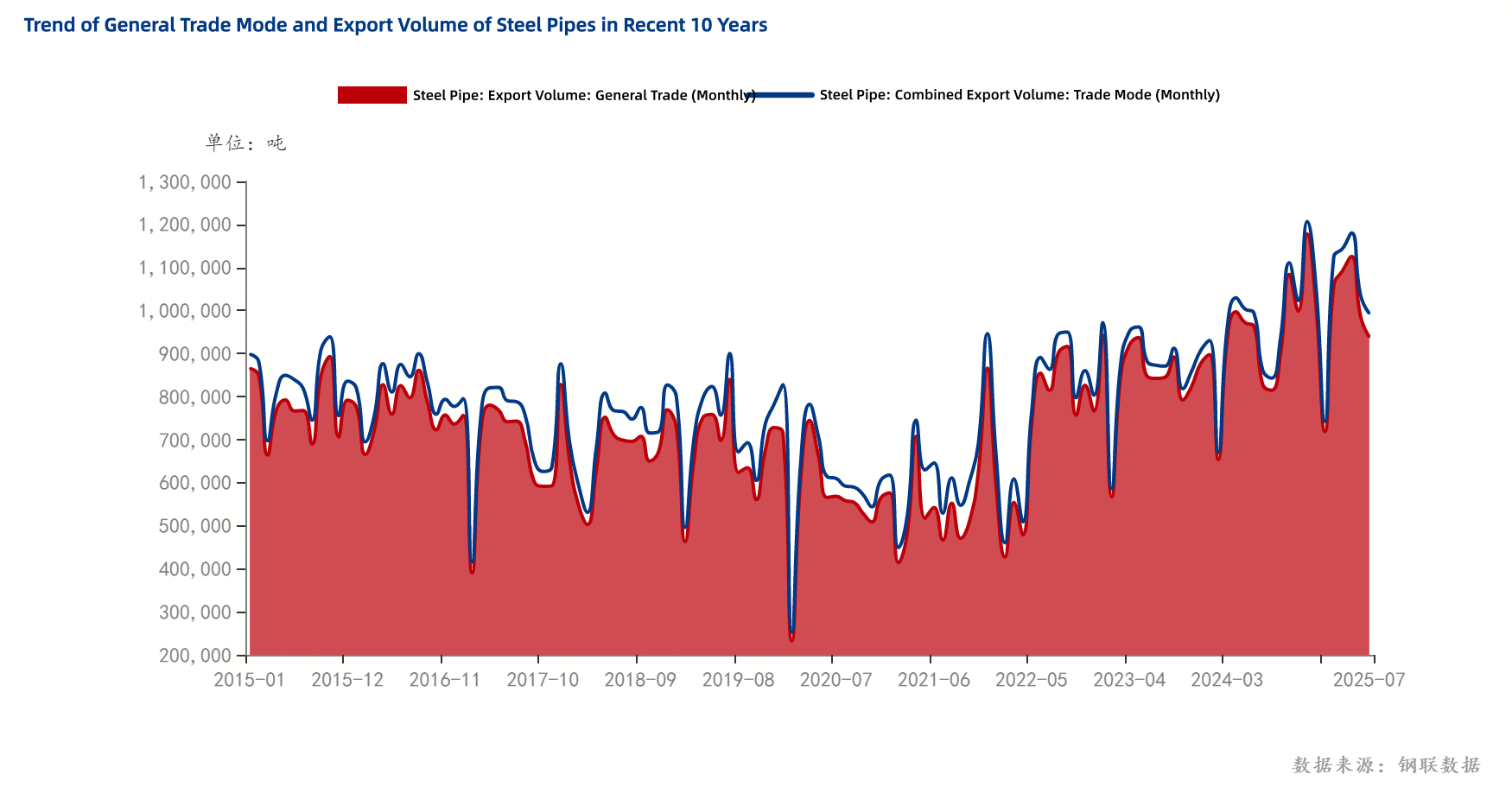
The general trade method occupies a dominant position in China's steel pipe exports.
Both the total volume of steel pipe exports and the volume of general trade exports have fluctuated with the global economic cycle over the past decade, showing an overall upward trend.
As the leading trade method, general trade has always been the core channel for steel pipe exports, with its export volume share consistently maintained above 90%.
General trade exports have consistently been the core support for China's steel pipe exports, characterized by "stable dominant position and high synergy with overall trend." This indicates that general trade is the "ballast stone" for China's steel pipe exports, reflecting strong direct international market demand for Chinese steel pipes and a relatively healthy trade structure where "direct transactions" are the primary mode of cooperation for the Chinese steel pipe industry in the international market.
Asia is the core market for China's steel pipe exports. Between 2015 and 2025, Asia has consistently ranked first in export volume among all continents and shows a trend of increasing year by year.
From 2015-2017, Asia's export volume stabilized in the 700,000 to 800,000 tons range. From 2018-2020, affected by external factors (such as trade frictions and the pandemic), Asia's export volume briefly dropped to 500,000-600,000 tons. After 2021, Asia's export volume rapidly rebounded and continued to climb, surpassing 1 million tons in July 2025, becoming the core driving force behind the growth of China's steel pipe exports.
Africa is China's second-largest market. Its export volume is volatile but remains high in the long term, nearing 120,000 tons in July 2025, serving as an important supporting market.
South America is China's third-largest market. Its export share is stable, and its volatility is less than that of Asia and Europe.
Europe is China's fourth-largest market. Its export share is the lowest, and its volatility is relatively large.
Transformation: International trade rules are undergoing profound changes. The deep implementation of the Regional Comprehensive Economic Partnership (RCEP) Agreement creates new opportunities for steel exports, promoting the transformation of China's steel trade from scale expansion to quality and efficiency. The industry faces severe challenges such as green barriers and trade frictions, but also welcomes development opportunities through technological upgrading and regional cooperation.
Future Trends: Looking ahead at the future development trends of China's steel pipe imports and exports, the industry stands at a critical juncture of transformation and upgrading. China's steel pipe imports and exports will exhibit three major development trends: "high-end, regionalized, and green."
Key Growth Areas: The Asian market will become the main growth point, benefiting from RCEP tariff concessions. Oil and gas development projects in the Middle East will drive a surge in oil casing exports.
Challenges and Strategies: While the international trade environment faces challenges such as US tariff policies and EU technical barriers, strategies such as developing the "Belt and Road" and establishing overseas factories can effectively address them. The Chinese steel pipe industry will maintain a leading position in the global market through technological upgrading and capacity optimization.