en
en 






Call
+8613406350006


The first week of February 2026 has witnessed a noticeable shift in the domestic seamless pipe market as the traditional Lunar New Year atmosphere intensifies. According to the latest data, the national average price for 108 by 4.5mm seamless pipes has experienced a minor downward adjustment, reflecting the localized price fluctuations in key industrial hubs. While the macro environment shows signs of long-term resilience, the immediate spot market is characterized by a "price without market" phenomenon, where quotes remain visible but actual transaction volumes have dwindled to seasonal lows.
From a pricing perspective, the national average across 28 major cities reached 4,215 yuan per ton as of February 6, marking a negligible weekly decrease of 1 yuan per ton. This stability underscores the firm cost-side support provided by raw material prices, even as downstream demand enters its deepest contraction of the year.
The raw material market for pipe billets has entered a phase of narrow fluctuations. Shandong pipe billet prices fell by 10 yuan per ton, while Jiangsu prices dropped by 20 yuan per ton. The price spread between Northern and Southern billets has narrowed to 270 yuan per ton, a reduction of 10 yuan compared to the previous week.
Mainstream seamless pipe mills have largely maintained their ex-factory prices. A survey of 34 sample mills indicates that manufacturers are opting for a "wait-and-see" strategy, keeping price lists stable to protect brand value and market expectations during the low-volume period.
The macroeconomic backdrop remains a point of interest for market participants. The global manufacturing PMI rose to 51 percent in January, a 1.5 percentage point increase that suggests a broader recovery in industrial sentiment. However, the domestic market is more focused on the immediate liquidity environment and the Federal Reserve’s anticipated decision to maintain interest rates in March, which has dampened earlier hopes for rapid global monetary easing.
The profitability of seamless pipe production has come under renewed pressure this week as the gap between raw material costs and finished product prices remains unfavorable for manufacturers. This "profit erosion" is particularly evident in the tolling mill sector, where the lack of vertical integration makes firms highly sensitive to even minor fluctuations in billet pricing and logistics costs.
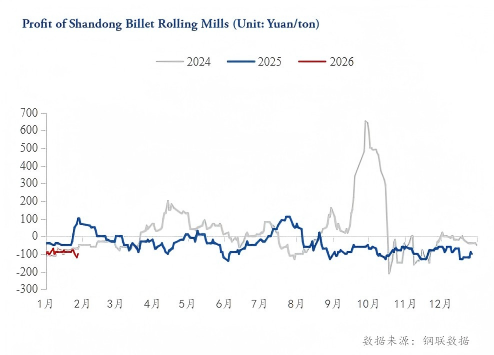
Shandong-based tolling mills have seen their profit margins shrink further, reaching a loss of 130 yuan per ton, a week-on-week decrease of 30 yuan. This persistent negative margin is a direct result of rigid billet costs failing to be absorbed by the stagnant finished pipe market.
In the East China market, Jiangsu tolling mills have hit a break-even point with zero profit per ton, down 20 yuan from the previous week. The compression of margins has led many mills to accelerate their holiday maintenance schedules to minimize operational losses during the demand lull.
Regional price monitoring shows that Shanghai market prices for the 108 by 4.5mm specification stood at 4,230 yuan per ton, while Nanjing and Hangzhou reported 4,120 and 4,170 yuan per ton, respectively. These prices have remained unchanged as local merchants begin to close their doors for the festive break.
Trading activity in Northern China has virtually ceased as logistics providers and traders have largely entered holiday mode. In the South, while a few manufacturing-related orders are being finalized, the overall market liquidity is insufficient to drive any significant price movements.
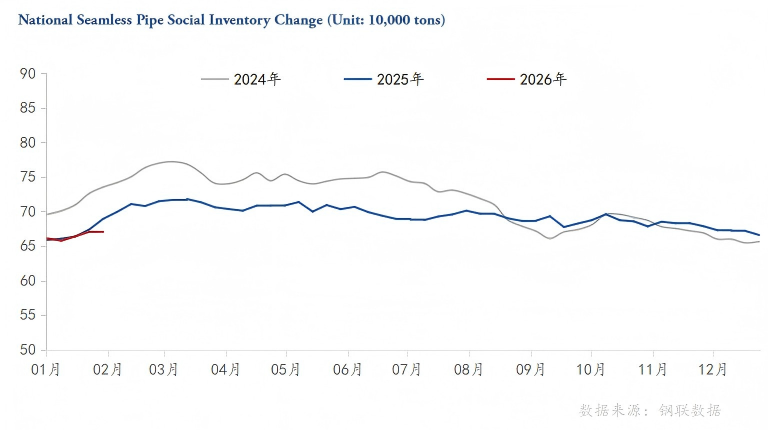
The transition from late January to early February has marked the beginning of a passive inventory accumulation cycle. As terminal demand halts, the resources currently being produced or arriving as part of "Winter Storage" contracts are moving into social warehouses, leading to a visible shift in the domestic inventory structure.
Social inventory levels across 123 surveyed merchants reached 675,700 tons, an increase of 5,800 tons week-on-week. This accumulation is primarily passive, driven by the delivery of pre-ordered stocks while downstream construction sites and factories remain closed.
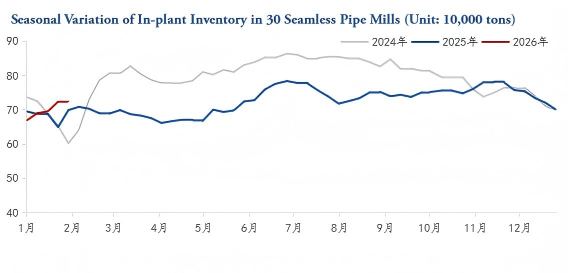
In contrast, mill-side inventory has shown a decrease. A survey of 30 major production enterprises with 101 production lines shows that in-plant inventory dropped to 702,500 tons, a weekly decrease of 19,100 tons. This suggests that mills are successfully transferring their stock to the social market, although their current inventory levels remain higher than the same period last year.
Raw material inventory at the factory level rose slightly by 9,800 tons to 288,700 tons. This indicates that some mills are strategically stockpiling billets to ensure a smooth restart of operations once the holiday maintenance period concludes.
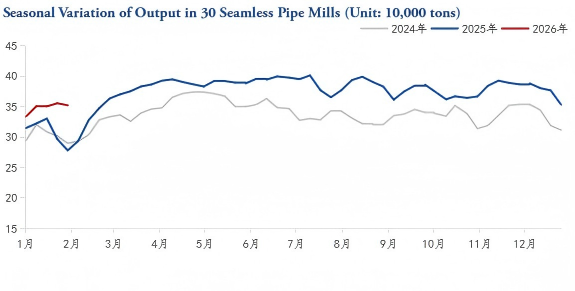
Production output has begun to retreat from its recent highs. Weekly output fell to 336,800 tons, a decrease of 15,200 tons. Correspondingly, capacity utilization dropped by 3.05 percentage points to 67.54 percent, and the operating rate fell to 65.35 percent. This downward trend in supply is expected to continue as more mills announce extended maintenance breaks.
Looking ahead to the next seven days, the domestic seamless pipe market is expected to remain in a state of seasonal stasis. The fundamental drivers of the market—demand and supply—are both at their weakest points, creating a stalemate that favors price stability over volatility. The focus of the industry has shifted from price discovery to capital safety and operational preparation for the post-holiday period.
From a demand perspective, the cold weather and the impending holiday mean that terminal construction in the North will not resume for several weeks. In the South, the manufacturing sector’s procurement has reached its limit, and no new significant demand is expected until late February.
On the supply side, the reduction in production output acts as a necessary buffer against the rise in social inventory. As more mills enter maintenance, the tightening of supply will prevent a surplus of "floating" inventory from depressing market prices.
Cost support remains a critical factor. Despite the slight softening of billet prices this week, the overall cost of production remains high. Pipe mills have little incentive or room to lower their ex-factory quotes, as doing so would only deepen their current losses without stimulating additional demand.
In conclusion, the seamless pipe market is entering a "hibernation" phase. Prices are likely to remain flat across most regions, supported by firm raw material costs and protected by the lack of active trading. We expect the national average to stay within a narrow range, providing a stable baseline for the market’s eventual post-holiday recovery.