en
en 


Call
+8613406350006


Winter has arrived, bringing with it the long-awaited annual "Winter Stockpiling" phenomenon. This year, the steel market is characterized by low inventory levels, with both mill and social stocks sitting near historical lows. Can this low inventory backdrop fuel enthusiasm for this year's winter stockpiling? Can steel prices successfully bottom out and rebound? How are market supply and demand changing? We briefly analyze these key questions below.
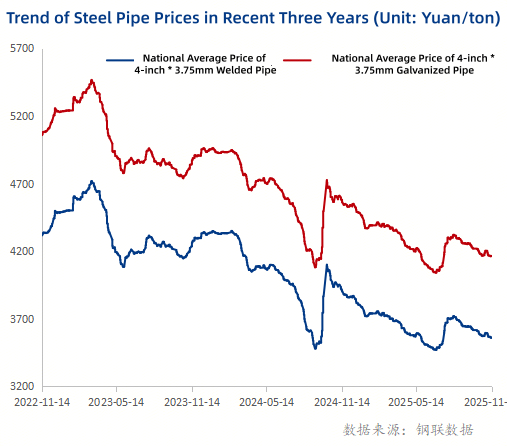
As of November 14, the national average price for 4-inch * 3.75mm welded pipe was 3,559 yuan/ton, and the national average price for 4-inch * 3.75mm galvanized pipe was 4,165 yuan/ton. Compared to the previous month, welded pipe fell by 36 yuan/ton, and galvanized pipe dropped by 33 yuan/ton.
Although the national welded pipe transaction volume (Mysteel survey of 178 welded pipe traders) showed a slight upward trend this week, with the average daily transaction volume increasing by 514 tons week-on-week, demand in the Northeast and Northwest regions is set to enter the traditional off-peak season due to weather constraints.
Despite the fact that mainstream national welded pipe mills primarily raised their ex-factory prices this week, most traders focused on reducing prices to move inventory. This lack of upward momentum means that recent prices generally present a pattern of easy to fall, hard to rise.
Mill Inventory Update:
According to Mysteel's survey, this week's welded pipe mill output was 306,400 tons, a week-on-week decrease of 200 tons.
Seamless pipe mill output this week was 392,500 tons, a week-on-week increase of 8,500 tons, and a month-on-month increase of 25,800 tons.
Overall mill inventory remains at a relatively low level compared to recent years, with some mills actively reducing production or undertaking self-storage to mitigate year-end inventory pressure.
Social Inventory Update:
This week, national welded pipe social inventory was 1.3435 million tons, a week-on-week decrease of 0.91%.
In the absence of clear positive macroeconomic policies and with black commodity futures showing volatile movement, market demand exhibits off-peak season characteristics. Traders are maintaining low inventory operations, with a more noticeable inventory reduction in the Northern regions, resulting in a slight overall decrease in welded pipe social inventory.
Inventory Outlook:
The backdrop of low overall inventory means that this "double reduction" (referring to the general trend of low mill and social stocks) helps alleviate market supply pressure and improves the supply-demand balance.
While the "double reduction" in inventory is an encouraging sign of potential demand recovery, its sustainability must be evaluated in conjunction with macroeconomic policies and mill production schedules. Potential risks must be closely monitored.
Intense Supply-Demand Contradiction:
Data released by the National Bureau of Statistics shows that from January to October, national real estate development investment totaled 7.3563 trillion yuan, a year-on-year decrease of 14.7%. Residential investment, in particular, fell by 13.8%.
New commercial housing sales area was 719.82 million square meters, a year-on-year decrease of 6.8%.
The slump in the real estate sector contributes to steel demand fatigue and a weak market trading atmosphere, leading to a situation where supply exceeds demand, resulting in significant inventory digestion pressure.
Weakened Cost Support:
Raw material prices, such as iron ore, are operating at high levels, but the release of steel mill capacity has diverged, and inventory pressure has become apparent.
Compounded by razor-thin mill profits, the room for price concessions is limited.
Most steel mills adopt a "follow the market" settlement model and offer limited preferential policies, such as "rebates on agreed volume" to agents. Some mills are attempting to hold prices firm to maintain essential cash flow.
Conclusion on Winter Stockpiling:
Given the current low level of mill inventory, the winter stockpiling market is primarily characterized by "minimal or no stockpiling."
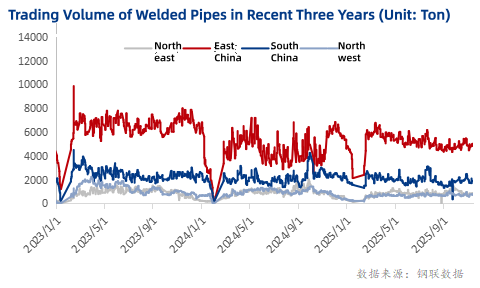
This year, the steel pipe market exhibits characteristics of a "mid-month turning point, product divergence, and regional differences." The core contradiction lies between weak demand and weakening cost support.
The market trend towards the year-end will depend on the efficacy of policy implementation and the actual completion rate of terminal projects during the winter.
Pipe mills and traders must manage their inventory and winter stockpiling strategies based on their own operating conditions, comprehensively evaluating the cost-benefit-risk triangle.
Mill policy tends to guide inventory transfer through favorable terms, while traders focus on price trends (price differences) and corporate liquidity.
Driven by expectations, steel pipe prices are anticipated to continue their weak adjustment. The focus in the short term should be on sales and shipments, avoiding aggressive actions, and utilizing a multi-dimensional assessment of factors including supply, demand, costs, policies, and market sentiment.