en
en 

Call
+8613406350006


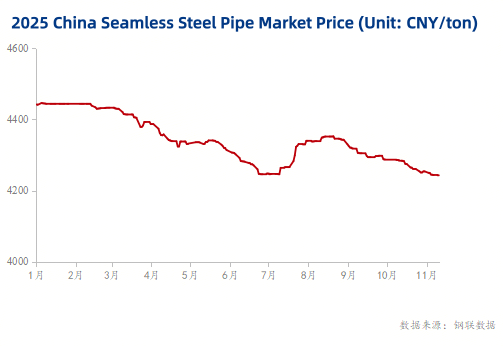
Overview:As we close 2025, a review of the national seamless pipe market reveals a challenging year. Prices began to accelerate downward in late March. Despite a brief rebound in early April, the general trend was irreversible, continuing a downward trajectory until mid-November, when prices broke through a new low for the past three years. How can the seamless pipe industry break through and survive in the coming year? This report provides a brief analysis.
The first three quarters of 2025 were characterized by a volatile downward trend.
Q1 Performance: Following the traditional Winter Break around the Spring Festival, the market entered a recovery phase. However, contrary to traders' expectations, prices fluctuated downwards after operations resumed. The pattern for Q1 was "high start, low finish"—stable to strong before the holiday, followed by a rapid decline afterward.
The Slump: Prices accelerated their decline in late March. A brief rebound in April failed to change the overall trend. By mid-November, prices hit a 3-year low.
Failed Expectations: The traditional "peak season" expectations did not materialize. The recovery of market demand was far below anticipation, and prices failed to find effective support due to sluggish demand.
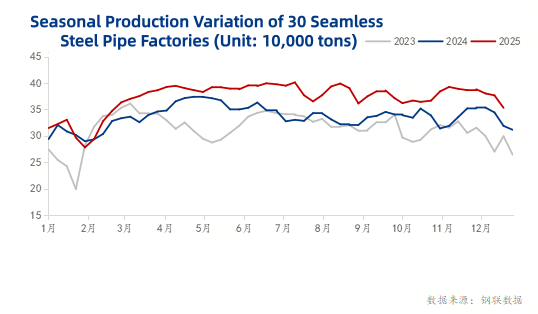
Production and inventory have declined for three consecutive weeks. According to the latest statistics from 30 production enterprises (101 production lines):
Output: 352,900 tons (Down 23,600 tons week-on-week; down 33,500 tons month-on-month).
Capacity Utilization: 70.77% (Down 4.73% week-on-week).
Operating Rate: 77.23% (Up 4.95% week-on-week, but down 0.99% month-on-month).
Mill Inventory: 700,400 tons (Down 20,000 tons week-on-week).
Raw Material Inventory: 276,200 tons (Down 24,700 tons week-on-week).
Against the backdrop of international instability, the steel industry has faced significant shocks. With the implementation of supply-side reforms and the release of the "15th Five-Year Plan," China's seamless steel pipe industry has entered a period of deep adjustment.
Capacity Expansion (2021-2025): Driven by rising international oil prices and domestic development, new production lines were added, increasing capacity by over 2 million tons annually. This rapid growth led to overcapacity, falling utilization rates, and intensified competition.
Structural Optimization: Upstream enterprises are extending their industrial chains. While some companies expanded products, others exited the market. In the coming years, the focus will shift from quantity to quality—improving utilization rates, product quality, and structural optimization. Backward capacity will be gradually eliminated.
In 2025, domestic apparent consumption increased, primarily supported by strong export demand and high-end manufacturing, which offset the decline in traditional construction.
Structural Transition: Steel consumption's reliance on real estate is decreasing. While growth in traditional "Big Infrastructure" slows, "New Infrastructure" and manufacturing remain resilient.
Future Growth: Looking ahead to 2026, as domestic incremental policies land and local debt pressure eases, project investment is expected to improve. Sectors like underground pipe networks and urban renewal will drive steel pipe consumption.
Conclusion: With anticipated recovery in investment and consumer confidence, industrial efficiency should improve. Overall, internal demand for seamless pipes is expected to strengthen next year, offering room for growth in consumption volume.