en
en 




Call
+8613406350006


This week, the domestic seamless pipe market experienced a slight downturn, with the national average price falling by 8 yuan/ton week-on-week. On the macroeconomic front, China's major economic indicators for 2025 have met expectations, with full-year growth projected at around 5%, maintaining its position among the world's leading economies with a total economic volume expected to reach approximately 140 trillion yuan. Looking ahead to 2026, the country plans to continue implementing a more active fiscal policy and a moderately loose monetary policy.
In the spot market, a divergence emerged: while the futures market trended upward and raw material prices strengthened, the cost support for pipe mills actually weakened in terms of transmission power. Under the influence of the seasonal off-peak period, market demand has gradually contracted. Traders remain cautious in procurement, prioritizing shipments over restocking. Under the combined effects of weakening cost transmission and shrinking demand, seamless pipe prices face potential downward pressure in the coming week.
Price Trends: A Slight Downward ShiftAccording to Mysteel data, as of December 19, the average price of 108*4.5mm seamless pipes across 28 major cities nationwide stood at 4,228 yuan/ton, reflecting a week-on-week decrease of 8 yuan/ton.
Raw Materials: Rising CostsContrary to the finished product market, raw materials showed strength. Shandong billet prices were raised by 30 yuan/ton, and Jiangsu billet prices increased by 20 yuan/ton week-on-week.
Mill Adjustments: Stability Amidst PressureA survey of 34 sample seamless pipe mills indicates that mainstream ex-factory prices remained largely stable, with individual mills attempting slight increases of 10-30 yuan/ton.
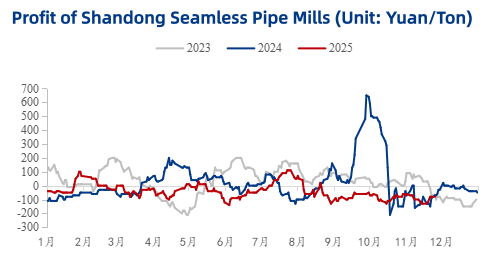
Profit Performance: Regional DifferentiationThe profit squeeze is evident as raw material costs rise while finished pipe prices stagnate or fall.
Shandong: Profits for billet-rolling mills dropped to -70 yuan/ton, a decrease of 10 yuan/ton week-on-week.
Jiangsu: Profits for billet-rolling mills stood at 170 yuan/ton, a decrease of 20 yuan/ton week-on-week.
East China Regional Analysis:The East China market reflected the broader "strong upstream, weak downstream" dynamic. While billet prices in Shandong and Jiangsu rose, mainstream pipe mills held quotes relatively firm. However, the seamless pipe market in East China saw mixed results: Shanghai prices edged up by 10 yuan/ton, while Hangzhou prices fell by 30 yuan/ton. Traders mostly maintained "as-needed" restocking strategies. With off-season transactions falling short of expectations, social inventory in the region continued a slight decline.
Inventory: Continued Destocking
Social Inventory: According to Mysteel's latest survey of 123 merchants, social inventory was 671,600 tons, a week-on-week decrease of 300 tons. Given the weak market outlook and poor demand, traders' existing stocks are sufficient to meet current needs, leading to low enthusiasm for restocking. Market inventory is expected to decline further next week.
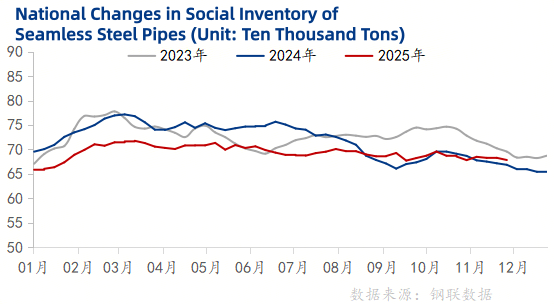
Mill Inventory: A survey of 33 production enterprises showed in-plant inventory at 720,400 tons, a significant drop of 13,400 tons. Raw material inventory dropped slightly to 300,900 tons. The reduction in mill inventory is largely attributed to environmental maintenance and production restrictions in the North, which slowed production rhythms while mills actively pushed shipments.
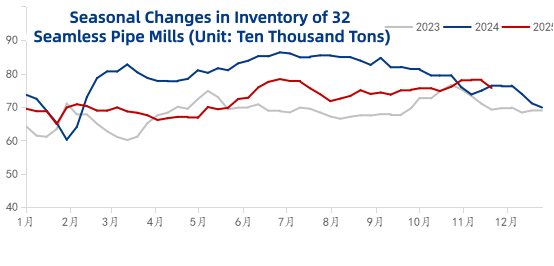
Production: Significant ContractionThis week, the output of sample pipe mills was 376,500 tons, a decrease of 3,700 tons. The capacity utilization rate fell by 0.74% to 75.51%. Notably, the operating rate dropped sharply by 4.95% to 72.28%, reflecting the impact of environmental restrictions and maintenance cycles.
Market Sentiment:This week, the black commodity futures market trended stronger, and raw material prices rose slightly. However, the support this provided to seamless pipe prices was limited. The transmission mechanism of costs from upstream to downstream is currently blocked by weak demand.
Upstream Outlook:Although the rise in billet prices formed weak cost support, mainstream pipe mills are exercising extreme caution in passing this pressure downstream. While mills have alleviated some inventory pressure through "environmental maintenance production limits" and active shipments, the possibility of "hidden" price cuts (promotional discounts) remains.
Downstream Outlook:The low enthusiasm for restocking among traders indicates that purchasing willingness at both the terminal consumption and intermediate trading links is extremely low. The market lacks the core momentum to drive price increases.
Conclusion:In a pattern characterized by "weak supply and weak demand," where the contraction in demand outweighs the reduction in supply, it is expected that national seamless pipe prices will operate in a stable-to-weak manner next week.