en
en 


Call
+8613406350006


Over the past five years, China's seamless pipe import market has exhibited the distinct characteristics of "Volume Reduction, Price Increase, and Structural Optimization." The fluctuating downward trend in total import volume confirms the acceleration of domestic substitution. However, the simultaneous rise in import value and average price reveals a persistent rigid demand for specific high-end products. This article analyzes the total volume, value, average price, structure, and varieties of seamless pipe imports to outline the challenges and opportunities facing the industry as it moves toward high-end development.
With the continuous development of the global economy and the domestic market's demand for high-quality seamless steel pipes, China has successfully achieved import substitution for certain high-end products in recent years, completing the localization process.
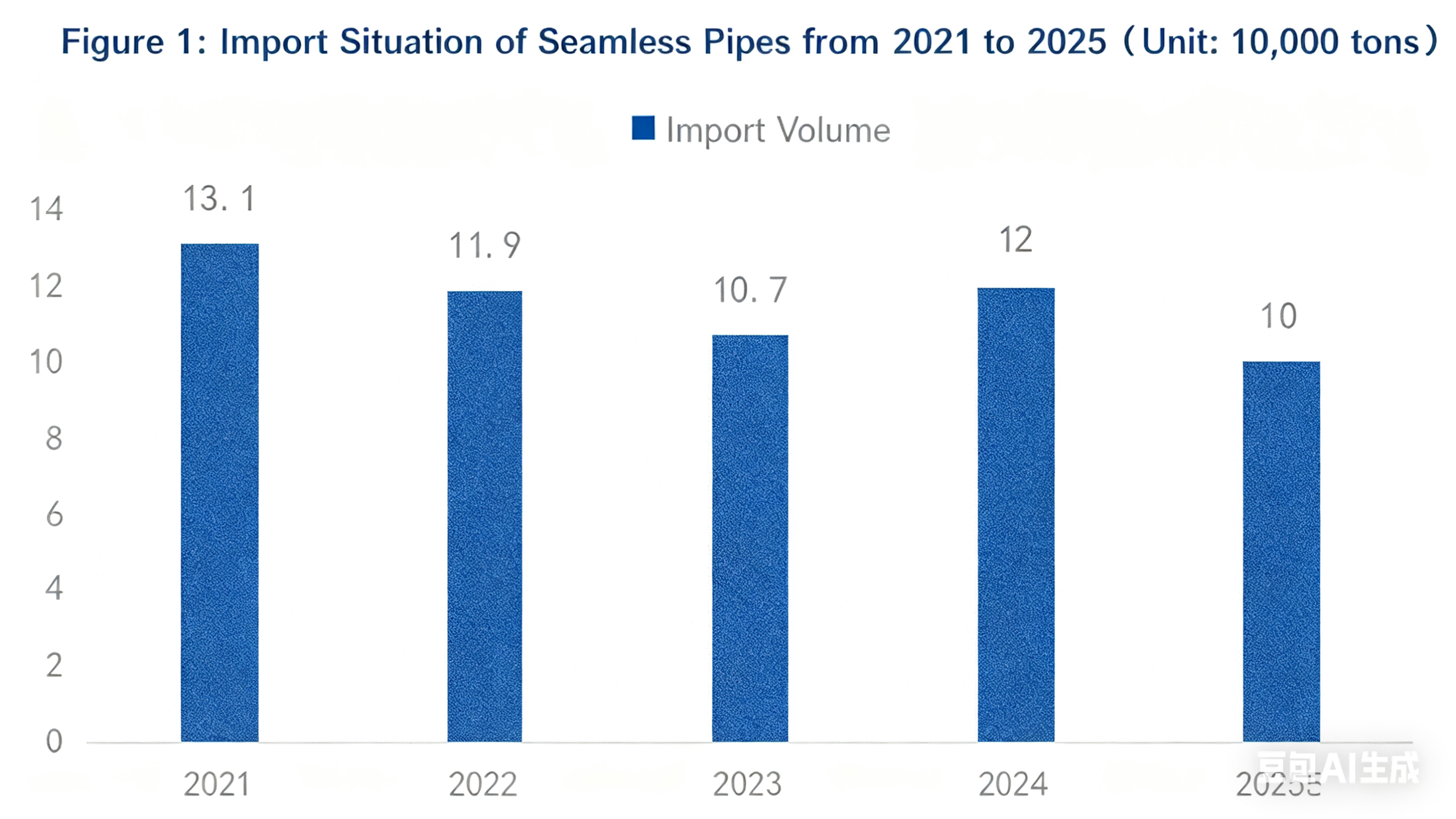
Volume Trends (2021-2025): China's seamless pipe import volume has shown a fluctuating trend.
2021: Import volume stood at 131,000 tons.
2023: Volume declined continuously to a low of 107,000 tons.
2024: Volume rebounded to approximately 120,000 tons.
2025 (Forecast): Data indicates a decline to 100,000 tons, a year-on-year decrease of 16.67%.
Overall, the "Decline-Rebound-Fall" trend is driven by multiple factors. The primary reason for the decline is the continuous improvement of domestic equipment technology, which has replaced some high-end imports. Additionally, surging overseas prices and export tariffs in some countries have suppressed import demand. The rebound in 2024 was driven by policies such as the Western Development Strategy, while the expected decline in 2025 signals further enhancement of domestic supply capabilities and reduced reliance on overseas sources.
Contrary to the downward trend in volume, the import value and average price of seamless pipes have generally followed an upward curve over the same period.
Price Surge: The average import price climbed from a low of $5,750/ton in 2021 to a peak of $9,650/ton in 2024. Although a slight pullback is expected in 2025, prices will remain at historically high levels.
Quality over Quantity: This divergence between price and volume reveals that China's seamless pipe imports are shifting from "Broad Quantity" to "Precise Quality." The reduction in total volume is mainly concentrated in mid-to-low-end products that have been localized. Meanwhile, continued imports consist mostly of high-end varieties with high technical barriers and strict quality requirements, thereby pushing up the overall import cost.
By Origin: Japan, Germany, and Italy DominateJapan, Germany, and Italy have consistently been the top three sources of China's seamless pipe imports. The top ten countries account for over 90% of the import volume, indicating high market concentration. While imports from Japan remain stable, imports from some European and American countries have declined significantly. Notably, imports from Romania in 2025 dropped significantly year-on-year, indicating a dynamic adjustment in the structure of import sources.
By Registration Location: East China is the Core HubImporting provinces are highly concentrated. Shandong, Shanghai, and Jiangsu consistently rank at the top, collectively accounting for about 50% of the national total. East China serves as the primary distribution hub for imports. In terms of average import price, provinces like Jiangsu and Tianjin consistently exceed the national average, indicating that these regions import products with higher added value.
By Trade Mode: General Trade dominatesFrom 2021 to 2025, cumulative seamless pipe imports totaled approximately 609,000 tons. General trade accounts for 76.27% of the cumulative total, making it the absolute dominant method. Other methods, such as processing trade and bonded warehousing, account for a small proportion. This reflects that the vast majority of imported seamless pipes are used directly for domestic market consumption rather than for reprocessing and re-export.
regarding import varieties, China still relies on imports from Japan, South Korea, Europe, and the US for certain high-grade alloy seamless pipes used in critical sectors.
Key Sectors: Oil and gas industry, nuclear power industry, high-end manufacturing machinery, and the boiler industry.
Specific Trends: Special material seamless pipes continue to account for a relatively large proportion. In 2025, demand for boiler tubes and geological drilling sleeves is relatively reduced, and imports for oil and gas drilling pipes are also down year-on-year.
Despite domestic technology meeting over 95% of construction needs, a gap remains between domestic products and advanced foreign levels in terms of quality stability, dimensional accuracy, and service life in critical high-end fields. This necessitates spending huge sums annually to import over 100,000 tons of high-end seamless pipes, reflecting that dependence in high-end fields remains the core challenge for the industry.