en
en 



Call
+8613406350006


This week, domestic seamless pipe prices showed a strengthening trend, with the average price increasing by 7 yuan/ton week-on-week. On the macro front, December 2025 data showed a continued expansion in CPI growth and a narrowing decline in PPI. Additionally, the Ministry of Water Resources has pledged to maintain large-scale infrastructure investment levels throughout 2026. In the market, the futures sector fluctuated upward, and raw material prices rose slightly. However, the "off-season effect" is now in full force: outdoor construction in the North has halted due to cold waves, leaving only sporadic restocking from the manufacturing sector. While some project completions in the South spurred local trading, overall demand remains weak and lacks sustainability. Consequently, seamless pipe prices are expected to remain stable next week.
【Price Dynamics】
Seamless Pipe Prices: As of January 9, the average price of 108*4.5mm seamless pipes across 28 major cities was 4,222 yuan/ton, up 7 yuan/ton week-on-week.
Raw Materials: Prices trended upward. Shandong pipe billets rose by 10 yuan/ton, and Jiangsu billets rose by 40 yuan/ton, slightly widening the North-South price gap.
Mill Adjustments: Most mainstream mills raised ex-factory prices by 20–100 yuan/ton this week.
【Profit Performance】
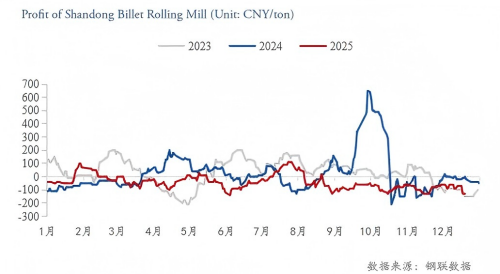
Shandong Tolling Mills: Profits remained flat at -100 yuan/ton.
Jiangsu Tolling Mills: Profits fell to 120 yuan/ton (down 10 yuan/ton).
Summary: Mill margins continue to be squeezed by high raw material costs. With weak downstream demand, merchants are prioritizing aggressive destocking over new purchases.
East China Regional Analysis:Raw material costs in the region rose (Shandong up 30 yuan/ton, Jiangsu stable), prompting mainstream mills to raise quotes by 30–100 yuan/ton.
Shanghai: 108*4.5mm rose 20 yuan/ton to 4,230 yuan/ton.
Hangzhou: Rose 30 yuan/ton to 4,170 yuan/ton.
Nanjing: Remained stable at 4,120 yuan/ton. Traders are restocking only for immediate needs, and "Winter Storage" sentiment remains highly cautious as the year-end approaches.
【Inventory Outlook】
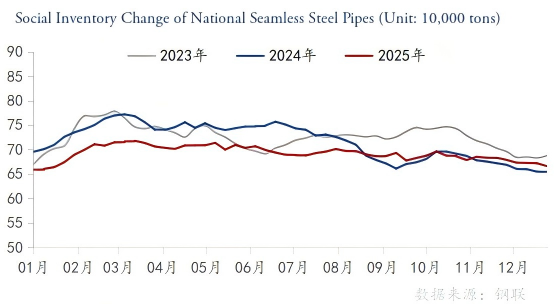
Social Inventory: Sample social inventory dropped to 657,400 tons (down 3,500 tons). Traders in the North are clearing stocks as terminal demand shrinks. As long-term contract arrivals increase in mid-January, the market is expected to shift into a "stockpiling" (accumulation) phase soon.
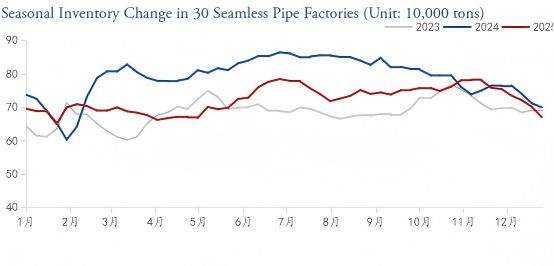
Mill Inventory: In-plant inventory rose to 690,100 tons (up 20,700 tons). With environmental maintenance ending in some Northern regions, production has resumed, leading to a rise in warehouse stocks.
【Production Outlook】
Output: Weekly production rose to 350,500 tons (up 17,200 tons).
Capacity Utilization: Increased to 70.29% (up 3.45%).
Operating Rate: Rose to 74.26% (up 3.96%). As maintenance schedules conclude, supply is beginning to recover, adding potential pressure to the market.
【Market Prediction】The market currently faces a tug-of-war between rising costs and collapsing demand:
Cost Support: Small increases in pipe billet prices and mill quotes provide a floor for current prices.
Supply Pressure: The increase in mill production and inventory levels indicates that supply is recovering faster than demand.
Demand Constraint: The "deep freeze" in the North has halted construction, and even in the South, demand is sporadic.
Conclusion: With traders focused on capital recovery and showing little interest in winter storage, the upward momentum for prices is blocked. We expect the national average price to remain stable next week, though some regions may see "covert price cuts" to encourage sales.