en
en 






Call
+8613406350006


The seamless pipe market in February 2026 was primarily defined by the extended "hibernation" period of the Lunar New Year (LNY). With the market closed for a significant portion of the month, terminal demand remained largely stagnant. Supply saw a dramatic contraction due to widespread facility maintenance, keeping market prices in a state of consolidation. While the post-holiday reopening in the final week of February did not spark an immediate "red-hot" surge, it set the stage for a strategic recovery.
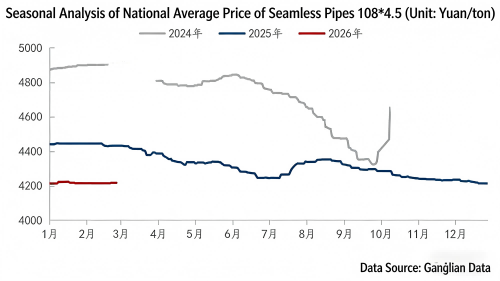
Price Performance: As of February 28, the national average price for seamless pipes (20#, 108*4.5mm) stood at 4,217 yuan/ton. This represents a marginal increase of 1 yuan/ton compared to the end of January, a growth rate of 0.02%. The lack of volatility was a direct result of the market entering holiday mode during the second week of February, with major trading activity only resuming in the final days of the month.
Theoretical Profit Compression: Profitability for pipe mills followed a downward trajectory throughout February. For sample enterprises in Shandong, average theoretical profits fell to -130 yuan/ton, a month-on-month decrease of 50 yuan. In contrast, Jiangsu-based mills maintained a steady average profit of 70 yuan/ton. The primary driver of this compression was the high cost of "Winter Storage" billets that began entering production lines, outstripping the stagnant growth of finished pipe prices.
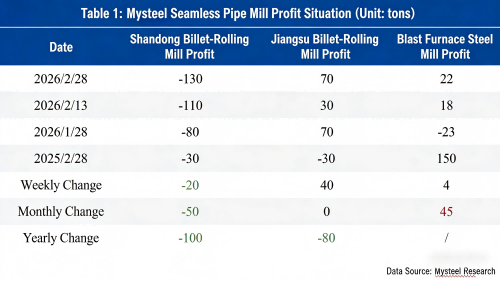
Blast Furnace Resilience: While tolling mills struggled, blast furnace-integrated pipe mills showed signs of significant recovery. Following adjustments in raw fuel prices, their profits rose to 22 yuan/ton by the end of February, an increase of 45 yuan month-on-month. This suggests that vertically integrated players are better positioned to weather the current price ceiling.
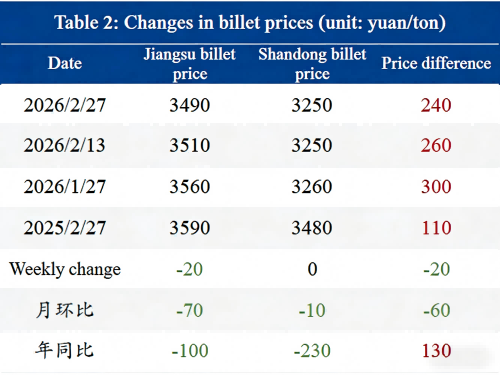
Billet Market Softness: Pipe billet prices outperformed pipes on the downside, with Shandong billets at 3,250 yuan/ton and Jiangsu at 3,490 yuan/ton—monthly declines of 70 yuan and 10 yuan, respectively. As the procurement cycle for winter storage concluded, trading sentiment for billets cooled rapidly. This price weakness in raw materials is expected to eventually allow for a recovery in pipe mill margins during the March production ramp-up.
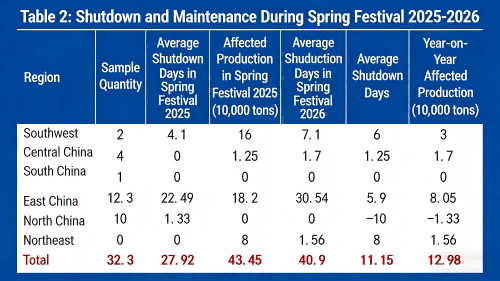
Supply dynamics in February were dictated by a heavier-than-usual maintenance schedule. The 2026 LNY impact was more pronounced than in previous years, driven by a combination of environmental protection mandates in Northern China and a proactive decision by many enterprises to extend holiday shutdowns to manage high production costs.
Maintenance Impact: Most mills entered maintenance around the 24th day of the 12th lunar month, with the majority resuming operations after the 8th day of the 1st lunar month. Mysteel’s survey of 33 major production enterprises indicates that the number of maintenance days and the total resulting production loss in 2026 significantly exceeded the levels recorded during the 2025 holiday period.
Production Metrics: By the final week of February, weekly output reached 293,600 tons. While this was a slight weekly increase of 9,800 tons as mills restarted, it represented a substantial monthly decline of 58,400 tons. The capacity utilization rate stood at 58.88%, down 11.71% month-on-month, while the operating rate fell to 53.47%.
Factory Inventory Accumulation: Due to the suspension of logistics and shipments during the LNY, factory inventories saw a sharp spike. By the end of the first post-holiday week, factory stocks reached 749,700 tons. Although this is 60,600 tons higher than the same period last year, it remains within the median range of the last several years, indicating that inventory pressure, while present, is not yet critical.
Recovery Pace: The speed of supply recovery in the first week after the holiday was relatively stable. Manufacturers are currently focusing on clearing the holiday backlog, and the transition of stock from factory warehouses to social warehouses is expected to accelerate as logistics return to full capacity in early March.
Demand in February hit its seasonal trough, with terminal consumption virtually non-existent for the middle two weeks of the month. While trading resumed in late February, the activity was largely confined to inter-trader circulation rather than actual consumption by end-users.
Transaction Volume: Data from 123 surveyed trading enterprises showed a daily average transaction volume of 9,684 tons for February. This is a sharp decline of 3,480 tons per day compared to January (a 26.44% drop) and a 19.49% decrease year-on-year. The "opening" week of the market saw some replenishment activity, but it lacked the breadth of a true demand release.
Terminal Laggards: Construction sites and manufacturing facilities have been slow to restart. Outside of major distribution hubs, consumption markets showed no immediate signs of a robust recovery. Traders currently maintain a "cautiously optimistic" stance, holding normal levels of social inventory while waiting for the actual start of the spring construction season.
Macroeconomic Tailwinds: March marks the opening of major national meetings and, crucially, the inaugural year of the "15th Five-Year Plan" (2026–2030). Market participants anticipate the release of significant pro-growth policies during these sessions. While the actual impact on physical demand will take time to manifest, the psychological boost to market sentiment is expected to provide a floor for prices.
International Variables: Geopolitical tensions in the Middle East present a dual-edged sword. While they may complicate the export logistics for seamless pipes, the resulting upward pressure on global energy and commodity prices acts as a bullish catalyst for domestic steel pricing structures.

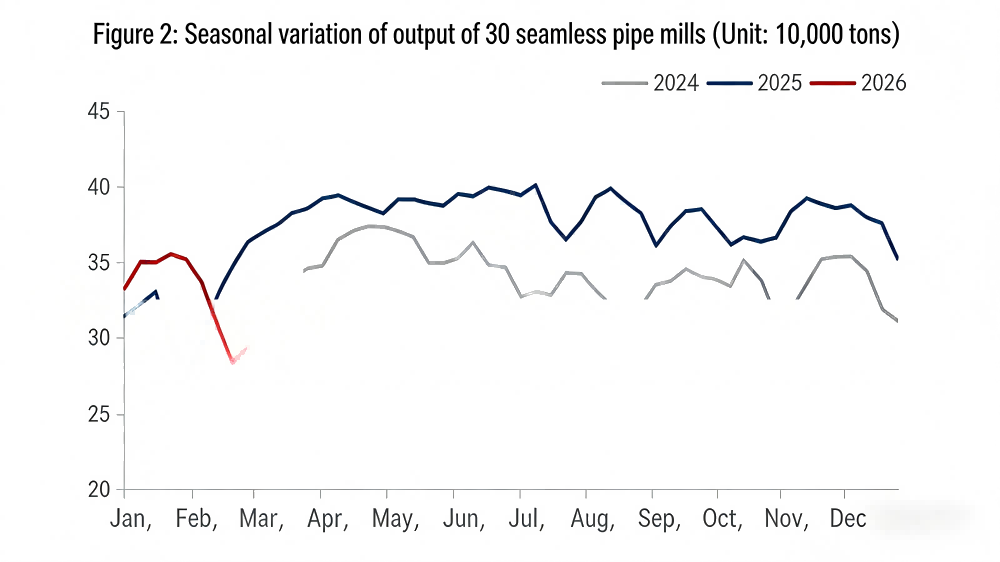
The market enters March in a state of "stabilized readiness." The dual weakness of supply and demand seen in February is expected to transform into a "dual growth" phase as the industry moves into the peak spring season.
Supply Trajectory: Supply is projected to recover rapidly to normal operating levels within the first half of March. Output will likely follow a "low-to-high" pattern throughout the month as mills ramp up production to meet anticipated seasonal demand.
Demand Expansion: A recovery in demand is inevitable in March. However, rather than an explosive "surge," the industry expects a gradual and steady rise. The extent of this growth will depend on the speed of infrastructure project commencements and the strength of the manufacturing sector following the policy signals from the upcoming national meetings.
Price and Inventory Outlook: Current social and factory inventories are at manageable levels. With the release of macro-economic stimulus and the seasonal return of downstream buyers, the supply-demand balance is expected to tilt in favor of sellers.
Conclusion: Given the firm support from raw material costs, the relatively healthy inventory levels, and the anticipated policy tailwinds, the national average price for seamless pipes is expected to experience a moderate upward movement in March. Market participants should watch for regional variations, particularly in areas with high infrastructure density.