Summary: Seamless steel pipes are often considered the "arteries" of the industrial sector, and their demand serves as a "barometer" for the macroeconomic climate. Although domestic real estate and infrastructure performance fell short of expectations in 2025, leading to a significant decline in demand for construction steel, Mysteel's calculations show that China's apparent consumption of seamless steel pipes actually increased in the first half of 2025. Due to its wide range of downstream applications, seamless steel pipe demand has shown strong resilience. This report systematically analyzes the demand structure of the Chinese seamless steel pipe market, dissects the current consumption status, driving factors, and changing trends in its core downstream sectors, and provides a future outlook based on macro policies and industrial development.
China's Recent Apparent Consumption of Seamless Steel Pipes
Since 2020, China's apparent consumption of seamless steel pipes has remained stable at around 24 to 26 million tons. Domestic demand has largely peaked, while exports have surged significantly with the evolving international situation. In 2024, China's seamless steel pipe exports reached a new historical high of 5.7211 million tons, accounting for 19.26% of total production. Against the backdrop of a general decline in steel prices and a sluggish real estate sector, China's apparent consumption of seamless steel pipes increased against the trend, reaching 12.6771 million tons in the first half of 2025, a year-on-year increase of 367,000 tons, or 3.0%. Unlike products such as rebar, seamless steel pipes benefit from diverse downstream applications.
Analysis and Outlook of Seamless Steel Pipe Demand Structure
2.1 Demand Structure by Industry
Seamless steel pipes are used in numerous downstream applications, including energy and chemical industries, mechanical manufacturing, real estate, steel structures, and automobiles. Demand for seamless steel pipes is most concentrated in the manufacturing sector. According to Mysteel's research, the two most critical downstream sectors are the energy and chemical industry and mechanical manufacturing, which account for 42.1% and 26.7% of demand, respectively. Together, they make up about 68.8% of China's total domestic seamless steel pipe demand.
2.2 Analysis and Outlook for Oil and Gas Exploration and Transportation
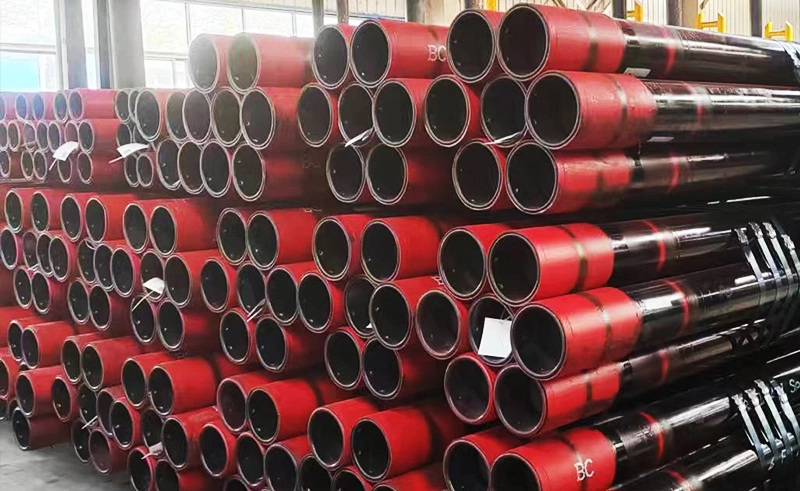
The "oil and gas exploration and transportation" sector is the largest traditional engine of seamless steel pipe demand. High-intensity exploration activities form the foundation of this sector's demand volume. It is estimated that drilling each well consumes hundreds to thousands of tons of seamless steel pipes, primarily casing and tubing.
Sustained Growth in Oil and Gas Production Lays the Foundation for DemandDuring the "14th Five-Year Plan" period, China maintained an annual crude oil output of over 200 million tons and rapidly growing natural gas production. This requires drilling tens of thousands of new wells to compensate for the decline in production from older oil fields, which directly ensures that the basic demand for oil country tubular goods does not shrink.
Rapid Development of Unconventional Gas (Shale Gas) Drives Demand for High-End PipesA key feature of China's oil and gas exploration during the "14th Five-Year Plan" was "stabilizing oil and increasing gas" and "advancing into unconventional and ultra-deep formations." Stable and growing output comes directly from continuous, high-intensity drilling and completion operations. The increasingly harsh exploration environments are driving a geometric increase in demand for higher-performance pipes. During the "14th Five-Year Plan," the focus of exploration shifted to shale gas, ultra-deep wells, and high-pressure corrosive gas fields, which all place exponentially higher demands on steel pipe performance.
Outlook for the "15th Five-Year Plan": As the national energy security strategy deepens and dependence on unconventional oil and gas resources further increases, the need for high-performance, highly reliable seamless steel pipes in oil and gas exploration will become even more pronounced. This sector will continue to be one of the most valuable and certain growth markets for the steel pipe industry.
Steady Progress in Pipeline Network Construction Supports Line Pipe DemandThe establishment of the China Oil and Gas Pipeline Network Corporation has accelerated the interconnection of the national oil and gas pipeline network, with new long-distance pipeline projects being a direct source of demand for line pipes. While main trunk lines typically use high-frequency welded pipes (HFW), seamless steel pipes remain the preferred choice for safety and reliability in station yards, crossings, extremely harsh environments, and urban gas networks. The continuous advancement of pipeline construction provides a stable market for seamless line pipes. For example, after the full completion of the China-Russia East Route, which can transport up to 38 billion cubic meters of gas annually, it extensively used high-grade large-diameter welded and seamless pipes (for branch lines and station yards), such as X80.
2.3 Analysis and Outlook for the Power Sector
The power industry is a stable and high-growth source of seamless pipe demand, primarily for high-pressure and ultra-high-pressure boiler tubes and heat exchanger tubes.
Thermal Power: In recent years, thermal power has seen a "small rebound" due to energy supply and peak shaving demands, leading to an increase in approved installed capacity for coal-fired power projects.
Nuclear Power: The policy of "actively, safely, and orderly developing nuclear power" has led to steady progress in the construction of new units. According to Mysteel's calculations, a 1000MW thermal power boiler consumes about 10,000 tons of steel pipes. With a thermal power generation capacity of 71.13 million KW in 2024, the steel pipe consumption for thermal power boilers was approximately 1 million tons in 2024.
The rapid development of clean, renewable, and efficient energy sources has caused the share of installed thermal power capacity to accelerate its annual decline. Although thermal power's installed capacity was hit hard at the beginning of the "14th Five-Year Plan," it later rebounded. Thermal power's role as a primary source of electricity remains unshakable in the short term. Thermal power units will encounter new opportunities during the "15th Five-Year Plan." According to data from the National Power Plant Boiler Industry Material Supply Association, the estimated consumption of boiler steel pipes is expected to reach approximately 1.207 million tons in 2025. From 2026 to 2027, boiler steel pipe consumption is projected to remain high, possibly reaching 2.414 million tons, with an average of 1.209 million tons per year. The demand for boiler steel pipes is expected to climb annually.
2.4 Mechanical Manufacturing and Industrial Equipment
Seamless steel pipes for mechanical manufacturing are one of the core pillars of seamless pipe demand. This sector accounts for about 26.7% of China's total seamless steel pipe demand, with a total volume of approximately 6.5 million tons, making it the largest seamless pipe consumer outside of the energy and chemical industries. Demand for seamless steel pipes in mechanical manufacturing is wide-ranging, with a diverse array of products including structural pipes, hydraulic support pipes, bearing pipes, conveyor roller pipes, and cylinder liner pipes. Additionally, as the world's largest producer and consumer of machine tools, China maintains a stable demand for high-quality bearing and structural pipes.
 en
en